
Synchronizing Systems
Please wait while we initialize your environment
Please wait while we initialize your environment
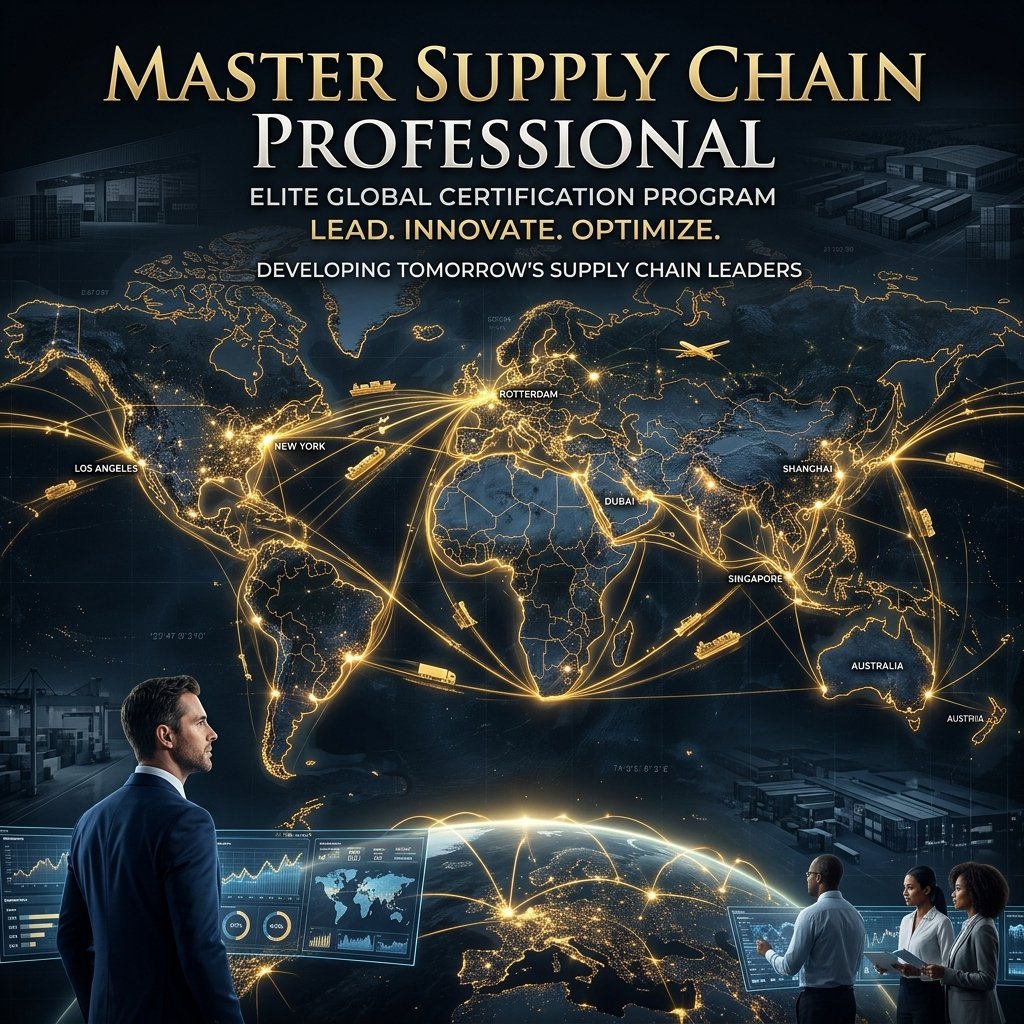
Comprehensive end-to-end supply chain mastery. Learn demand planning, procurement, logistics, and digital transformation to lead modern, resilient supply chain operations.
Created By
LSIT Global Faculty
Last Updated
April 2026
Language
English / Bengali
Course Description
The Master Supply Chain Professional Program is a comprehensive, industry recognized professional development course designed to build advanced expertise in modern, end-to-end supply chain management. The curriculum covers all major supply chain domains— including demand planning, procurement, logistics, operations, inventory management, technology, quality, risk management, and sustainability.
This program also enhances strategic thinking, analytical capability, and leadership skills essential for senior supply chain and operations management roles.
Course Objective
Upon completion of the program, participants will be able to:
• Understand end-to-end supply chain processes, global frameworks, and industry best practices.
• Strengthen analytical, forecasting, and planning capabilities for effective demand and supply management.
• Develop proficiency in procurement, supplier management, logistics, and operations execution.
• Navigate global supply chain networks, trade compliance, and cross-border regulatory requirements.
• Identify, assess, and mitigate supply chain risks to improve resilience and continuity.
• Apply digital supply chain technologies—ERP, WMS, TMS, IoT, AI/ML—to enhance efficiency, transparency, and accuracy.
• Incorporate sustainability, ESG principles, and responsible sourcing into supply chain decisions.
• Build leadership competencies to drive strategic supply chain transformation.
Course Outline
Chapter 1: Supply Chain Foundations & Demand Management
• Overview of supply chain concepts, flows, and value creation
• Demand patterns and fulfillment strategies (MTS, MTO, ATO, ETO)
• Forecasting models, accuracy measurement, and data analysis
• Sales & Operations Planning (S&OP) fundamentals
Chapter 2: Global Supply Chain Strategy & Network Design
• Aligning supply chain strategy with organizational goals
• Network design, segmentation, and optimization
• Circular and sustainable supply chain principles
• End-to-end visibility, metrics, and performance dashboards
• Global trade rules, customs requirements, and compliance
Chapter 3: Strategic Sourcing & Procurement Management
• Procurement strategies and Total Cost of Ownership (TCO)
• Supplier evaluation, selection, and RFx processes
• Contracting fundamentals, Incoterms, SLAs, and governance
• Supplier relationship management and negotiation tactics
• Global sourcing, outsourcing, and supplier risk considerations
Chapter 4: Operations Planning & Production Management
• MRP, CRP, and capacity planning
• Shop floor control, scheduling, and workflow management
• Production planning methodologies
• Theory of Constraints (TOC)
• Integrating operations with demand and supply plans
Chapter 5: Inventory Planning & Materials Management
• Inventory strategies and optimization techniques
• EOQ, safety stock, and reorder point calculations
• ABC/XYZ classification and segmentation
• Materials handling and stockroom operations
• Inventory performance measurement and accuracy
Chapter 6: Logistics, Warehousing & Distribution
• Transportation modes, routing, and cost management
• Warehouse layout, design, and operational excellence
• Distribution and last-mile delivery optimization
• Reverse logistics and return management
• Shipping documentation and global trade compliance
Chapter 7: Supply Chain Collaboration & Leadership
• Customer Relationship Management (CRM)
• Collaborative frameworks (CPFR and strategic partnerships)
• Cross-functional alignment and communication
• Ethical standards, governance, and professional conduct
• Leadership competencies for supply chain managers
Chapter 8: Supply Chain Risk & Resilience
• Identifying internal, external, and global supply chain risks
• Risk assessment tools: FMEA, risk matrices, prioritization
• Resilience, redundancy, and business continuity planning
• Cybersecurity, data privacy, and regulatory risks
• Designing agile, flexible, disruption-ready supply chains
Chapter 9: Quality Management & Continuous Improvement
• Lean principles and waste reduction (7+1 wastes)
• Kaizen, 5S, and Just-in-Time (JIT)
• Six Sigma fundamentals and DMAIC methodology
• Quality tools: 7QC, RCA, 5 Whys, Fishbone, SPC
• ISO 9001, QMS implementation, and supplier quality management
Chapter 10: Digital Supply Chain, Technology & Transformation
• Advanced Planning Systems (APS) and optimization technologies
• ERP, WMS, TMS, MES and integrated system architectures
• IoT, blockchain, automation, and connected systems
• AI/ML forecasting, predictive analytics, and RPA
• Digital twins, Industry 4.0, and supply chain innovation
• SCOR model applications and benchmarking
Course Outcomes
Upon successful completion of The Master Supply Chain Professional Program Program, participants will be able to:
• Master end-to-end supply chain processes and operational workflows.
• Apply forecasting, inventory models, and planning tools for data-driven decision-making.
• Strengthen procurement and supplier management using structured frameworks.
• Optimize logistics, warehousing, and distribution operations for higher efficiency and service excellence.
• Implement continuous improvement using Lean and quality management tools.
• Build risk-resilient and agile supply chain strategies.
• Leverage digital technologies to create integrated, transparent, and high-performing supply chains.
• Contribute strategically to organizational growth and competitive advantage.
Enhance your expertise in global supply chain management and accelerate your journey toward vendor certification success
Share your thoughts and help others choose the right course.
"I want to know more details about this course"
Assistant Manager
"I am interested"
Assistant manager
"I am interested."
EC (administration)
"Would like to know details"
AEPD
Secured via CyberSource & Stripe
Global Authorization Protocols
Encrypted Transmission
Global Standards Validated